

Rebels with/without a Map
A July ode to Stan Grof’s birthday, American Independence Day and the legacy of Martin Luther on the New Age.

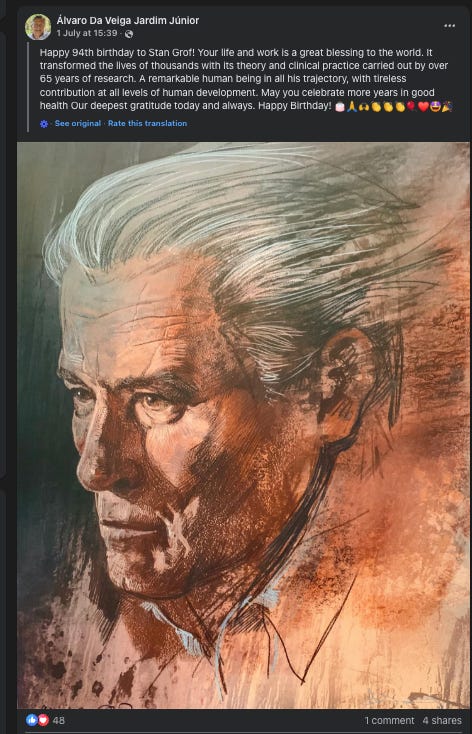
Stan Grof is a distinctly American figure. A rebel immigrant on the frontiers of consciousness.
Kurt Andersen’s book Fantasyland: How America Went Haywire, A 500-Year History helped me to understand this further (thanks to B-Boy Bungus for the recommendation).
“America was created by true believers and passionate dreamers, by hucksters and their suckers—which over the course of four centuries has made us susceptible to fantasy, as epitomized by everything from Salem hunting witches to Joseph Smith creating Mormonism, from P. T. Barnum to Henry David Thoreau to speaking in tongues, from Hollywood to Scientology to conspiracy theories, from Walt Disney to Billy Graham to Ronald Reagan to Oprah Winfrey to Donald Trump. In other words: mix epic individualism with extreme religion; mix show business with everything else; let all that steep and simmer for a few centuries; run it through the anything-goes 1960s and the Internet age; the result is the America we inhabit today, where reality and fantasy are weirdly and dangerously blurred and commingled.”
Anderson gives an overview of the religious origins of America via Reverand Martin Luther and Protestantism. Luther, like Grof, claims to liberate the individual from entrenched authority, only to spawn new institutions, new dogmas, and new gatekeepers.
Both movements begin with a (noble?) demand: return truth to the people—stop mediating it through corrupt institutions.
“Luther had two bigger ideas, revolutionary ideas, that became foundational both to his religion and to America. He insisted that clergymen have no special access to God or Jesus or truth. Everything a Christian needed to know was in the Bible. So every individual Christian believer could and should read and interpret Scripture for him- or herself. Every believer, Protestants said, was now a priest…
However, out of the new Protestant religion, a new proto-American attitude emerged during the 1500s. Millions of ordinary people decided that they, each of them, had the right to decide what was true or untrue, regardless of what fancy experts said. And furthermore, they believed, passionate fantastical belief was the key to everything. The footings for Fantasyland had been cast.”
Grof also had two revolutionary (though not necessarily unique) ideas that became foundational to the New Age therapeutic worldview.
First, that psychiatrists and medical professionals had no exclusive claim to psychological truths (I agree), and mental illness/psychosis were not always pathology (also agree).
Second, that access to the true nature of consciousness comes through holotropic states, e.g. LSD or Holotropic Breathwork.
Why are holotropic states important? Because Grof believes the psyche is the gateway to the entire cosmos—literally. According to Grof, the psyche is not each person’s unique combination of bio-psycho-social-spiritual factors. Instead, the psyche is a portal to all of existence—the personal is really the universal. Deep inner experiences are not strictly personal—they are cosmic Truth.
Grof bolsters his position by tying it to similar ideas from Tantra, the Buddha, Cabala, Gnosticism, and the Hermetic tradition. This is reasonable and interesting to explore. However, as is typical of Grof, his review of these traditions seems only for the sake of demonstrating the validity of his own great personal insights.
Grof further validates his insights as Science by citing David Bohm’s holographic paradigm, arguing that each person contains the whole of reality.
“David Bohm’s work has been one of the most important contributions to my efforts to establish connections between my own findings concerning the nature and dimensions of human consciousness, on the one hand, and the scientific worldview, on the other. I found his holographic model of the universe invaluable for my own theoretical formulations. The fact that Karl Pribram’s model of the brain is also based on holographic principles has been particularly important for this bridging work”- Stan Grof, Cosmic Game, The: Explorations of the Frontiers of Human Consciousness (1998)
Grof, like many other New Age theorists, uses Bohm’s holographic universe to lend scientific credibility to his claims. Bohm was a respected scientist. However, his theories, including “implicate order” from his later work, are not testable hypotheses (i.e. not science).
There is a well-established lineage of New Agers using Bohm’s speculative theory as evidence for their personal belief systems. Richard Bube’s review of Kevin Sharpe’s book, David Bohm’s World: New Physics and New Religion, is helpful for this topic.
“The author [Sharpe] continues with a discussion of the five major ingredients in Bohm's metaphysics: reality has an endless depth; parts of reality relate to each other; reality is constantly in movement; the movement of reality is creative; and reality divides into levels that are in systems of hierarchies.
To these may then be added Bohm's religious ideas, influenced at least to some extent by an interest in Eastern mysticism: consciousness is a material process in the implicate order; the consciousness of humanity is one; the holomovement is the life energy; consciousness is affected by fragmentation that is the source of human self-deception; and the significance of ‘the beyond.’
Beyond the explicate and the implicate, beyond the holomovement, there is something about which we can say nothing except that it is. We cannot in any way approach, measure, or know it. It eludes the grasp of thought, but is the source for all. For Bohm, the beyond is the domain of the sacred, the spirit, the holy, God. Compassion, intelligence, love, insight, he believes, comes from this beyond.
We are limited in how much we can know and understand, but insight can come from the beyond to change brain matter.
For Bohm insight is the supreme intelligence. To move toward relieving the chaos of fragmentation in our world requires insight to reorder people's minds. In particular, several close insightful people need to set up a single mind from their collective individual minds.”
As I discuss here, Grof’s work quietly supports a similar idea to Bohm’s “single mind” concept. If we can get enough “leaders” who are “under a stronger influence of the perinatal energies than the average person”, we can shift all of humanity. An extension of this is Rick Doblin’s white-suit evangelising appeal for a global spiritualised society by 2070. It’s all well and fine if not everyone or even most normies aren’t on board for the mission—they only need to get a critical mass of Shiva-types.
So, in brief, both Luther and Grof started out as critics of institutional authority, calling for personal revelation, direct experience, and the right to question dominant systems of knowledge. Yet both end up creating systems that claim to liberate but end up imposing a different set of ideological rules.
“Apart from devolving religious power to ordinary people—that is, critically expanding individual liberty—Luther’s other big idea was that belief in the Bible’s supernatural stories, especially those concerning Jesus, was the only prerequisite for being a good Christian. You couldn’t earn your way into Heaven by performing virtuous deeds. Having a particular set of beliefs was all that mattered. (And in strict early Protestantism, even those didn’t guarantee you entry.)”
Luther’s rejection of the Catholic Church’s centralised control and his insistence on personal access to scripture aimed to democratise spiritual knowledge. Instead, America ends up fracturing into countless sects, each with rigid interpretations and charismatic leaders. Instead of the authority of the priest class, America ends up with the authority of the most charismatic narcissist in town (cue Joseph Smith). Today, on a national level: Trump and RFK Jr.
For Grof, his critique of psychiatry began as a legitimate rebellion against the authoritarian treatment of mental suffering. He rejected the cold rigidity of diagnoses and the reduction of human experience to biological processes.
But rather than shifting to a genuinely pluralistic or critical framework, Grof became bound to his own ecstatic revelations. During Grof’s first LSD trip in 1956, he felt himself dissolve into cosmic unity. Grof concluded that because he felt it, it must be metaphysically True.
The logic of Protestant individualism paved the way for Grof to call his feelings Science. Grof needed America, just as America needed (and got) Grof.
Luther and Grof also reproduce a core assumption that plays out on the micro and macro-scale: that male, Eurocentric experience is a valid proxy for universal human truth. Their critiques target institutions, while they leave power untouched where it’s most deeply rooted. I’ll leave that topic for elsewhere…
Going back to Bube’s review of Sharpe’s book on Bohm:
“To perceive what is beyond the implicate and explicate orders and therefore beyond thought, Bohm states that thought must go...To do this is the first step of religion; it is the aim of meditation. Meditation transforms our minds and moves them beyond the implicate order. According to Bohm, consciousness can break free of its constraints by leaving thought behind to become something quite new.
Sharpe considers whether process philosophy might be an adequate way to describe Bohm's ideas, but concludes that it probably is not. He considers Capra's attempts to relate quantum theory with Eastern mysticism and decides that it is a case of Capra's religious belief influencing his science. Finally he argues that Bohm is using his religious ideas in physics. This is especially true of his idea of "undivided wholeness," which "has its roots in religion or mysticism, and it may or may not be useful in physics." Stephen Hawking has been especially critical of such an approach, and Sharpe quotes Hawking as saying, "(it) is absolute rubbish ... The universe of Eastern mysticism is an illusion.... A physicist who (tries) to link it with his (or her) own work has abandoned physics."3
Sharpe's comments at this point are perceptive:
Bohm proposes it as a physical theory, but it is still subject to the testing ground of physics. Religion can make a second contribution: it can strengthen believers' dedication, enthusiasm, and tenacity to try to have their ideas accepted as physical theory.... Many religions, including Christianity, have much to say about the nature and direction of the physical world. They should not be afraid of bringing these ideas in appropriate forms, to the sciences. As hypotheses they are still, of course, in need of factual support.
Whether or not Christianity has anything to say about the nature of the physical world can certainly be debated. But note that all of these comments have to do with the use of religious ideas to guide scientific theory. They do not become accepted science because of their religious appeal. They are valid only if they result in science that can be experimentally tested. Nor do they deal with the issue of science leading to changes in theology.”
The issue is not the existence of these ideas. That’s fine, even interesting and exciting! The issue is that they are smuggled into scientific discourse without empirical grounding, justified by their intuitive or spiritual resonance. Grof uses the legitimacy of Bohm as a scientist to justify his personal feelings as scientific discourse (as many others have).
Movements that begin as critiques of power often end up reproducing their own kind of orthodoxy. Paul Ricoeur called this the "second naïveté": the tendency to tear down one set of beliefs only to embrace a new one without sufficient critical distance to meaningfully separate it from the original orthodoxy.
Going back to Fantasyland and the founding of America…
“A bestselling work of fiction in the 1800s, The Legends of the American Revolution, 1776, included a story called “The Fourth of July, 1776.” A quasi-angel—“a tall slender man…dressed in a dark robe”—mysteriously appears among the Founders in Philadelphia and delivers a five-minute speech (“God has given America to be free!”) that makes them finally stop arguing and sign the Declaration. Then he mysteriously disappears. Americans from across the religious spectrum chose to regard that fantasy as historical fact, and they still do today1…
As the Yale religious historian Jon Butler has written, the early United States was an “antebellum spiritual hothouse,” Christian faith blending freely with folk magic—belief in the occult, clairvoyance, shamanic healing, and prophetic dreams, much of it old folk superstition no longer constrained by Puritan doctrine and order. America was ripe for and rife with magical thinking of every kind.
Indeed, I’m proposing that the Second Great Awakening in the first half of the 1800s was just one part of something larger—the Great Delirium. During this First Great Delirium, new fantasies of every sort erupted—not just religious but cultural, pseudoscientific, utopian, and political, all variously radiant and lurid, feeding one another in a synergistic national crucible. Over the next few chapters, I’ll discuss each domain. But first, let’s look at how American Christianity wildly reinvented itself.”
The cycle continues…
[Quoted footnote] “A century later, in a commencement address at his alma mater, a celebrity alumnus told the story as actual eyewitness history, attributing it to Thomas Jefferson. The 1957 commencement speaker was Ronald Reagan. Later, as president, when he repeated the story at length in a Fourth of July essay he published, his handlers evidently persuaded him to call it a “legend” and delete the Jefferson attribution.” - Kurt Andersen, Fantasyland